
ISCOR student credits international conference with fostering different perspectives and student connection
Tyler Paulo speaks to the value of attending the 2026 Peace Summit of Emerging Leaders in Bangkok with ISCOR peers.
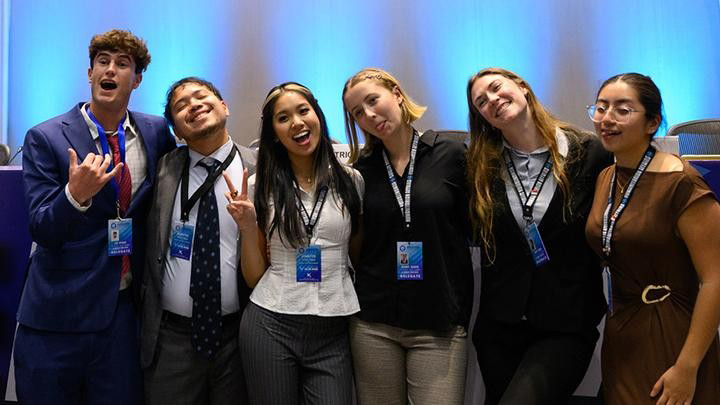
In January, the Peace Summit of Emerging Leaders in Bangkok, Thailand’s United Nations Conference Center, welcomed students from around the world to participate in an annual international conference centered on world peace.
Hosted by Humanitarian Affairs Asia, a global peace organization, the three-day event featured various planned talks from guest speakers and networking opportunities with fellow delegates. Speakers in the lineup included a German volunteer medic in the Ukraine, Ruben Mawick, and Emi Mahmoud, a Sudanese genocide survivor.
Among the delegates were five students from San Diego State University’s International Security and Conflict Resolution (ISCOR) department: Chloe Seger, Tyler Paulo, Jess Seguin, Leo Hymus, Samantha Alvarado, and Justina Pow.
Paulo, in the final semester of his studies at SDSU, learned about the Global UN Peace Summit through a canvas announcement from Luca Dal Pubel, lecturer in political science, who prompted his students not to miss out on the opportunity after a scheduling conflict prevented him from attending as a speaker. Paulo reached out to the event organizers via email to receive an official application, which involved writing three different essays about his relationship to peace.
Before he knew it, Paulo was in a group chat with four of his peers planning the details of traveling to Bangkok. Although he was not originally well acquainted with the other SDSU delegates except for Seger, who had been the teaching assistant in his class with Dal Pubel, Paulo now describes their connection as fast-friends, bonding over the experience of international travel and peace talks. “It was really fun. We didn’t know each other going in, but then we all [shared accommodations] when we were over there and just had a good time together,” Paulo said.
This bonding speaks to one of the conference’s primary points of success: networking. “I think the main goal of the Peace Summit is to connect potential future young leaders together in a sort of networking space,” Paulo said. “The overarching goal of the conference is to achieve peace, but of course peace is not an easy thing to achieve in this world.”
Peace may not be an immediately achievable goal, but cultivating a community that is both capable and willing to work toward it is. Language such as “bridge building” and “harmonious” framed meal times and breaks as opportunities to meet and get to know other students from different countries and walks of life, carving opportunities for connection directly into the conference schedule.
“I think the conference was most successful in bringing these intelligent young people in a room together and having them have a dialogue regarding peace and how we, as a generation, can achieve it,” Paulo said.
Paulo credits the international aspect of this experience as particularly valuable to both the students and the summit’s overall success. In the current socioeconomic climate, it is more accessible for students to come together outside of the United States. Paulo makes the point that “there are huge immigration hurdles that [international] students would have to go through” to enter the United States.
Further, the Thailand meeting-point gave Asian delegates a foremost seat at the table by specifically ensuring their ability to attend. “There were over 60 countries represented, a lot of which were from Asia,” Paulo said. “It was really cool to interact with a lot of perspectives that we don’t really hear in the United States.” The Bangkok location allowed a diverse array of voices to be heard — a deeply important tenet of any peace talk.
The people were the highlight of Paulo’s time at the 2026 Peace Summit. He revels in the connections he made and the stories he heard. Paulo cites the stories of genocide survivors, child soldiers, and Ruben Mawick as particularly impactful. “These are stories you might hear or watch on TEDTalk or Youtube, but if you are not actually there in the room with them and you are not able to shake this person’s hand or see them with your own eyes … there’s still a layer you are missing.”