
David Cline endeavors to make peace seen and heard on the border as new Hansen Peace Chair
2025-2027 Hansen Peace Chair organizes border projects surrounding grassroots skateboarding culture and oral storytelling.
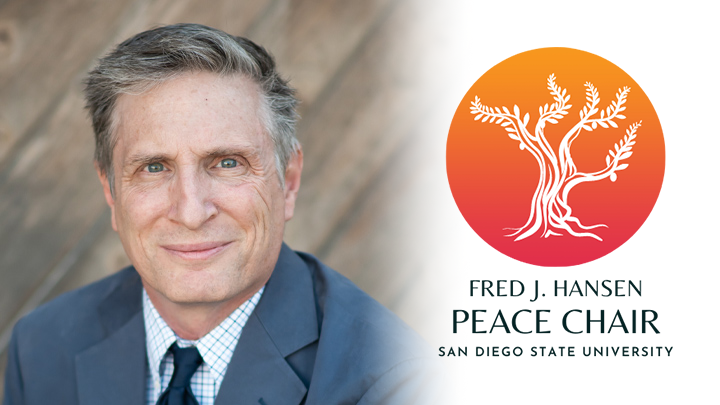
In the summer of 2025, David Cline — an oral history scholar and history professor with a specialization in social justice and the civil rights movement — was selected for the two-year term as Hansen Peace Chair, carrying on 25 years of work dedicated to peace before him. The title is awarded on behalf of the Fred J. Hansen Foundation, whose focus on bringing the world together through nonviolence funds a multitude of peace-promoting projects within the College of Arts and Letters.
Cline’s work in oral history has long centered on human connection, bringing him to public-facing roles in the past and sparking his initial interest in the Hansen Chair when he arrived at San Diego State University in 2017. Cline got involved almost immediately, participating in a conference about nonviolence around the world at the invitation of chair at the time, Hank E. Johnson. “I’ve always been thinking about this position in the back of my mind as something that would be interesting to work with,” Cline said.
Now, nearly a decade later, Cline’s interest has blossomed from a passive interest to a promising reality. He began his work as Hansen Chair in the fall of 2025 under the proposed theme "Peace Seen and Heard: Graphic and Aural Images from the U.S. Struggles with Peace and Violence.” Though his plans underwent many alterations, his focus remained on the United States-Mexico border. As a both geographically and kairotically prevalent feature of San Diego culture, Cline views the topic as a perfect jumping-off point from past chairs’ emphasis on “community building” and “peace in the international perspective” while simultaneously “really [tying] into one of the major interests of the university right now: border studies.”
Cline is organizing two primary projects to realize his passion for peace seen and heard on the border: “Stories from the Border” and “Boarder Crossings: Patinetas, Communidad y Paz.” Cline’s responsibilities as Hansen Peace Chair center solely on bringing these programs to life, but this by no means suggests ease or simplicity. “All aspects of the project become my duty … I’m on the phone all of the time, sending emails, driving all around San Diego and Tijuana with skateboards in my car … It’s very hands-on and, in that way, adds something very different to my life than archival research,” Cline said.
“Stories from the Border” was born during a visit to Instituto de Investigaciones Historicas at the Universidad Autonoma de Baja California (UABC) in Tijuana, where Cline and several SDSU organizations such as SAGE and the digital collections team at the library under Lisa Lamont were collaborating to digitize their archives. Colleagues at the university offered Cline a tour of their oral history collection, revealing an extensive compilation of over 700 oral histories in the early stages of digitization dating back to the 1950s — all focusing on life on the border. The Fred J. Hansen Foundation’s support allows Cline to offer assistance with the online presentation of this impressive collection.
The project intends to continue digitizing the existing material while conducting additional interviews — this time with a concentration in housing along the border. As a committed oral historian, Cline understands the importance of accessible storytelling. The partners are currently discussing SDSU’s role in providing additional online access to the existing bilingual metadata and transcripts, with plans to contribute new material on housing issues. “I really believe in the power of story, in listening to the people who are participants in history tell, understand, and make meaning of their own history,” Cline said.
Where “Stories from the Border” is largely about auditory peace, “Boarder Crossings: Patinetas, Communidad y Paz” casts a wider net through the world of skateboarding. Cline immersed himself in the board sports popular to the region when he moved to the area, contributing to the formation of the Surf/Skate Studies Collaborative and collaborating on a new minor and various academic works. A colleague from Italy who was finishing his Ph.D. dissertation at the time, Andrea Buchetti, added to the conversation in a thesis discussion of the underground economy and arts movement stirring in the skateboarding factories of Tijuana, where skateboarders/workers were designing blank boards to trade.
Cline saw these actions as peaceful protests in the face of many otherwise overwhelmingly violent border policies. “The alternative peaceful response is a kind of grassroots democracy at the people's level, building community despite that border being there,” Cline said. Skateboarders, as notorious community-builders, demonstrate the ability to hold a shared vision across border lines with the power to “speak back from the peaceful grassroots.”
Cline and Buchetti have teamed up to both demonstrate and foster this microcosm of peace, gathering 26 skateboard artists — 13 from the United States and Mexico alike — to design blank skateboards commenting on peace and the border in whatever artistic way they wish. Their visual acts of peaceful protest will be displayed in art exhibitions in Centro Cultural Tijuana (CECUT) and San Diego’s Centro Cultural de la Raza this summer.
“It’s really gratifying to see something like this that really does speak to our shared humanity in the face of some really oppressive circumstances,” Cline said. As he endeavors to make peace both seen and heard on the border, he continues to return to that which grounds him: making a genuine difference. “I wanted to create projects that do real good work in the world.” Whether via a showcase of grassroots skateboarding culture along either side of the border or the many oral stories told and left unsaid in university archives, Cline intends to make the most of his time and resources as Hansen Peace Chair. “I’m very grateful to the family and the organization that has funded this and made this possible. I hope we’re doing them justice.”