
Research discoveries ignite conversation in CAL religion courses
Ishai Mishory, assistant professor in the Department for the Study of Religion asks students to meditate on Judaism, sustainability and spirituality.
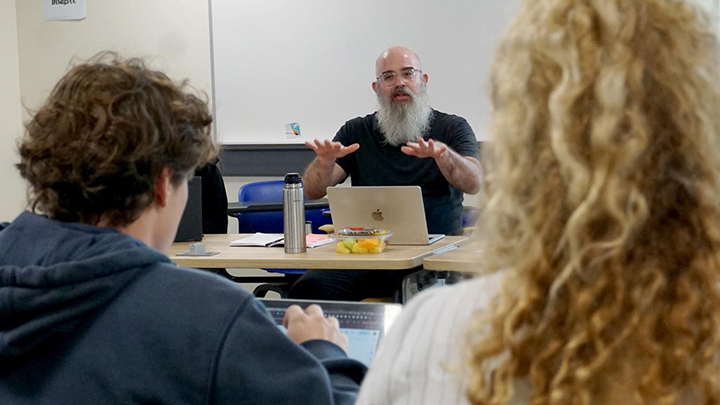
When students in San Diego State University’s study of religion courses gather in Assistant Professor Ishai Mishory’s classes, they don’t simply discuss religion — they unravel centuries-old treasures linking art, identity, and spirituality. From the printing presses of Renaissance Italy to the sustainability challenges of the modern world, Mishory’s research sparks lively conversation about what it means to live thoughtfully in relation to religion, history, and society.
Mishory not only holds a bachelor’s degree in graphic design, but obtained his master of arts, master of philosophy, and doctorate in religious studies at Columbia University in New York — and spent time in Italy on a Fulbright Fellowship. Now, he brings his creative energy and scholarship to the College of Arts and Letters.
Mishory shares more details on his research in a Q&A.
Q: Tell us about your research?
A: I mostly write about two subjects. The first is the problematics, or possibility really, of a Jewish secularity: the way we understand “secularism,” certainly in the United States, is predicated on a Christian separation of “church” and “state,” of something called “religion” and something called “the world,” which doesn’t really exist in Judaism. So why do we read that Jews only “became secular” in the 19th century (by the way, we also read that that’s when they first became “religious”)? Investigating Jewish culture and history – in my case, Renaissance Italy – has helped me ask better questions about this set of problems. The questions animating my research – is Judaism a religion, a culture, or perhaps a shared history? – also feature prominently in the courses I teach on Judaism.
My second passion is book history, and specifically the making of “Jewish books” broadly defined. The early modern press floor was an exciting meeting place where Jews and non-Jews worked together, trying to make sense of their similarities and differences, and I have written about books that an Italian-born, 16th-century Jewish printer produced in central Italy and in Constantinople. Mainly known for his religious tomes, I have focused on ‘secular’ books he edited and printed, including a hilarious, beautiful compendium of animal fables (the first-ever illustrated book in Hebrew), Italian-language titles of action-packed chivalric poetry, and a primer on arithmetic. My questions about the different texts, about the books’ physical makeup and about their Jewish and non-Jewish readerships combine history, art history, theory and comparative religious studies to better make sense of those questions regarding Jewish religion and identity I mentioned above.
Q: What are fascinating facts you have discovered in your research after visiting more than 40 archives and libraries during your Fulbright Fellowship in Italy?
A: In Italy, I actually discovered some material that hadn’t been analyzed by bibliographers. My new discoveries allowed me to rethink, to reconceptualize, Jewish identity in Renaissance Italy using this new material.
The animating question, as I have mentioned, is on the possibility of an “early modern Jewish secularity.” I happen to believe that much of the history written about Jewish communities in places like Italy in the Renaissance has been influenced by contemporary and modern historiography in Germany and in the United States.
So where the United States, a later Protestant culture, is very much a culture with a supposed separation of church and state, that is not the case regarding the people that I write about, who lived in the beginning of modernity, at a time when Protestantism was just beginning to take shape really. An anecdote on this related to my research has to do with the fact that when Martin Luther translated the Bible from Hebrew to German, he did so using an edition of the Bible printed by the printer I follow, Gershom (Hieronymus) Soncino.
I write about the time these modern ideas we use today, “religion” versus “irreligion” or “secularism,” were invented. And my somewhat controversial contention is that we should read the lives, the culture, of these early modern Jews in Italy as already “secular.” I reject this separation of a world of belief versus a world of secular politics, because it was irrelevant to these Jewish people, and indeed, to the people surrounding them at that time.
Q: How do you engage students in your two courses: Judaism and Spirituality and Sustainability?
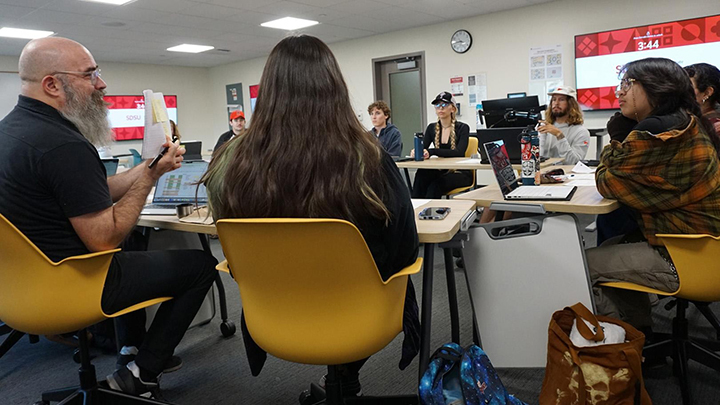
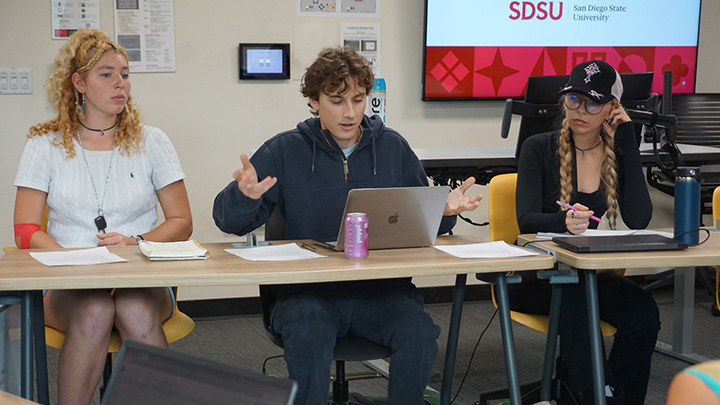
A: In the Judaism (RELS 320) course, I encourage students to talk, watch a movie, discuss in small groups, do a puzzle – any activity to strike up and allow conversation. The idea is that we sit for 75 minutes talking to each other about texts that we've read. Whatever activity we do is meant to ignite their discussion. The question of this course is, what is Judaism? So we spend some time on different propositions: is it a religion, a culture, an ethnicity, or perhaps a shared history?
The Spirituality and Sustainability (RELS 376) course focuses on comparative religion – it asks, how have the great traditions conceptualized humans’ relation to nature? We read texts from and about Islam, Christianity, Judaism, Buddhism, Hinduism, Kumeyaay cosmography and other sources. Since many readings in this course feature an anthropological focus, we investigate writing on the self and on ‘the other’ in a religious context.
Q: Your work blends history, philosophy, and religion. How do you hope students will be inspired to continue their own research on these subjects?
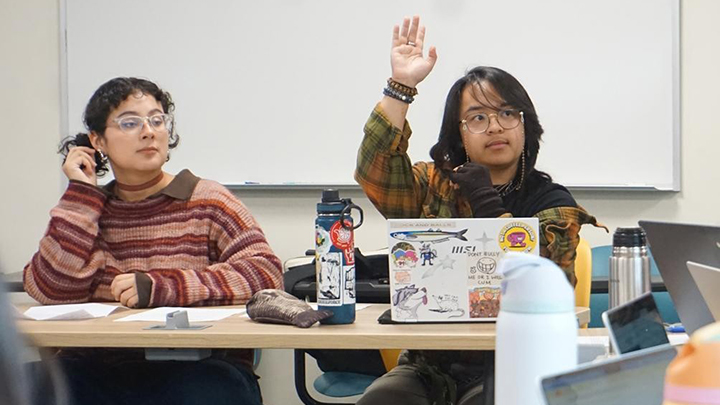
A: The interdisciplinary nature of my research and teaching hopefully means I can meet different students where they are – honestly, what interests me above all else is to get students thinking, reading, to get them excited about participating in discussion of the class text and connect them to their own lives. The idea is not to tell students what the “truth” of any religion or culture is but rather to help them formulate better questions about (in the case of Judaism) Jewish history and identity, or (in a general sense) about their own lives, the environment and the traditions we inherit.
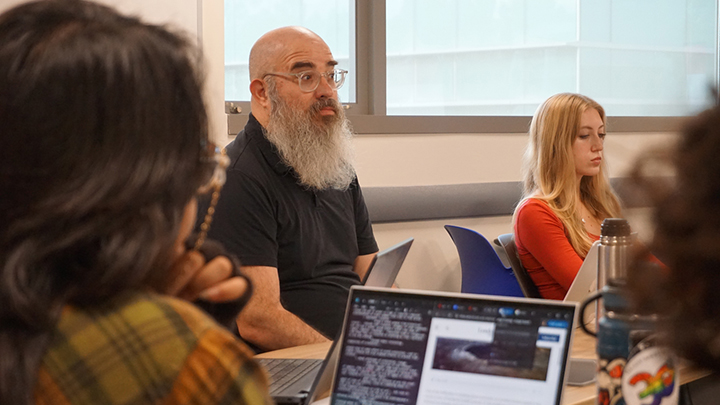
I have found my students at SDSU thus far to be wonderfully curious. They bring very diverse viewpoints to the class, and are eager to discuss and have those viewpoints heard and challenged. And I think that on the whole they’ve found the readings I have presented to be interesting — I hope my classes are a gateway for them to do more rigorous reading.
 Open the image full screen.
 Open the image full screen.
 Open the image full screen.
 Open the image full screen.
 Open the image full screen.

Spring 2026 Courses with Ishai Mishory
- Jewish Thought PHIL 576 / REL S 376 / MALAS 600D
- Spirituality and Sustainability (GE) REL S 581